 blog
blog
Reduce Fuel Costs for Service Fleets: 7 Proven Strategies
Table of Contents
- Why Fuel Costs Matter for Service Fleet Operations
- 1. Implement Fleet Fuel Management Software to Track Real-Time Consumption
- 2. Optimize Routes to Minimize Unnecessary Mileage and Fuel Consumption
- 3. Coach Drivers on Fuel-Efficient Driving Techniques for Fleets
- 4. Establish Preventative Maintenance Fleet Fuel Programs
- 5. Reduce Unnecessary Engine Idling and Idle Time
- 6. Leverage Fuel Cards and Bulk Purchasing Strategies
- 7. Measure ROI and Set KPIs to Reduce Fuel Costs Long-Term
Reduce Fuel Costs for Service Fleets: 7 Proven Strategies
Last Updated: July 29, 2026
Service fleets waste thousands of dollars monthly through idling, inefficient routing, poor driver habits, and deferred maintenance. Fuel typically represents 25-35% of total operating costs for service-based businesses. A fleet spending $100,000 annually on fuel could recapture $10,000 to $20,000 by implementing the right controls and monitoring systems. This guide covers seven strategies to identify waste, optimize operations, and measure financial impact.
1. Implement Fleet Fuel Management Software to Track Real-Time Consumption
Direct visibility into fuel consumption is essential. Fleet fuel management software connects to vehicle telematics systems to capture real-time data on fuel usage, idle time, engine diagnostics, and driver behavior, translating that data into actionable alerts and reports.
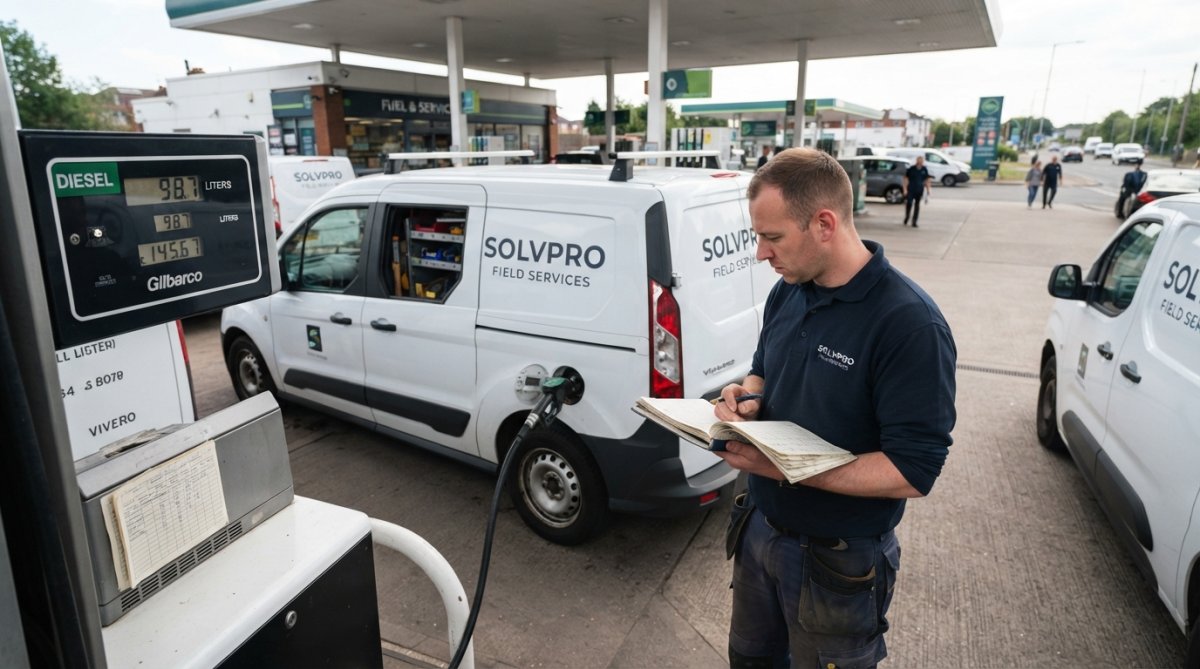
How telematics and GPS tracking reduce waste
Telematics devices log engine performance, location, and fuel consumption. GPS tracking reveals actual routes and identifies unnecessary detours. Combined, these data streams reveal patterns manual observation would miss. Telematics data often shows fuel economy drops 15-20% during peak traffic due to harsh acceleration and braking, not congestion alone. A driver aware of this pattern can adjust throttle control and anticipate stops earlier, improving fuel economy across hundreds of service calls monthly.
GPS tracking also reveals redundant routing. A dispatcher might send three vehicles to the same neighborhood on different days when consolidating those calls into a single route would save 40 miles of fuel.
Identifying idling and engine performance issues
A diesel engine idling burns roughly 0.8 gallons per hour. A service technician waiting for a customer can waste 2-3 gallons in a single afternoon. Telematics systems track idle time automatically and generate reports showing which drivers and vehicles idle most. Once you have the data, driver coaching becomes targeted: "Your idle time last week was 4.2 hours, that's about 3.4 gallons of wasted fuel."
Engine diagnostics captured through telematics flag mechanical issues before they become fuel-economy killers. A clogged air filter, misaligned wheels, or failing oxygen sensor can reduce fuel economy by 5-10%. Preventative maintenance triggered by diagnostic codes keeps vehicles running efficiently.
2. Optimize Routes to Minimize Unnecessary Mileage and Fuel Consumption
Poor routing wastes fuel at scale. Route optimization software uses algorithms to analyze scheduled jobs, vehicle capacities, time windows, and current locations, then generates the most fuel-efficient sequence. The difference between manual dispatch and optimized routing can be 10-15% fewer miles driven.
Using dispatch software to reduce total miles driven
Modern dispatch systems integrate with work order management platforms to pull all jobs for a given day or week. The optimization engine considers geographic clustering, vehicle capacity, time windows, driver availability, and skill matching. A service fleet managing 50 jobs across a metro area might reduce daily mileage by 80-120 miles using optimized routing. Over a year, that's 20,000-30,000 fewer miles and proportionally less fuel consumed.
Real-time rerouting based on traffic and job priorities
Static routes become inefficient when traffic changes or emergency jobs arrive mid-shift. Real-time rerouting allows dispatchers to adjust routes on the fly, accounting for current traffic and new requests. A driver heading toward a delayed job can be rerouted to a nearby call, eliminating wasted drive time. A fleet making 5-10 real-time route adjustments per day can save 5-10% on fuel across the week.
3. Coach Drivers on Fuel-Efficient Driving Techniques for Fleets
Driver behavior is one of the most controllable factors in fleet fuel consumption. A driver who accelerates smoothly, maintains steady speeds, and avoids excessive idling can achieve 20-30% better fuel economy than one with aggressive driving habits in the same vehicle on the same route.
Reducing harsh braking, rapid acceleration, and speeding
Telematics systems monitor acceleration, braking, and speed in real time, flagging harsh events and speeding. When a driver accumulates harsh events, they receive automated coaching alerts. The message is specific: "You had 12 harsh acceleration events this week. Smooth acceleration saves fuel and reduces wear on the transmission."
Speeding significantly increases fuel consumption. Every 5 mph above 50 mph on the highway reduces fuel economy by approximately 7%. A driver maintaining 60 mph instead of 70 mph on a 100-mile highway route saves roughly 2-3 gallons. Over a fleet of 20 vehicles, that's 40-60 gallons per long-distance trip.
Monitoring driver behavior with telematics alerts
Automated telematics alerts create accountability without requiring supervisors to manually review every drive. A driver sees real-time feedback in their mobile app or receives a text alert when they exceed a speed threshold or brake hard. The most effective programs combine automated alerts with periodic coaching conversations where supervisors review monthly reports and discuss patterns.
4. Establish Preventative Maintenance Fleet Fuel Programs
A well-maintained vehicle uses less fuel. Neglected vehicles accumulate mechanical issues that degrade fuel economy silently until consumption spikes 10-20% above baseline. Preventative maintenance programs scheduled by mileage or time intervals ensure consistent care: oil changes, filter replacements, spark plug inspections, tire pressure checks, and alignment verification.
Tire pressure and aerodynamics impact on fuel economy
Underinflated tires increase rolling resistance, forcing the engine to work harder. A tire 10 psi below recommended pressure can reduce fuel economy by 3-5%. A tire pressure monitoring system (TPMS) automates this, alerting drivers or dispatchers when pressure drops below threshold. Regular pressure checks keep tires at optimal levels.
Modern vehicles communicate diagnostic trouble codes through the OBD-II port. Telematics systems read these codes continuously, flagging issues like failing oxygen sensors or catalytic converter problems, all of which reduce fuel economy. A scheduled maintenance program addresses these issues early, preventing months of fuel waste.
| Maintenance Item | Interval | Fuel Economy Impact | Priority |
|---|---|---|---|
| Tire pressure check | Weekly | 3-5% if underinflated | High |
| Oil and filter change | 3,000-5,000 miles | 2-3% if overdue | High |
| Air filter replacement | 15,000-30,000 miles | 2-5% if clogged | High |
| Spark plug inspection | 30,000 miles | 1-3% if fouled | Medium |
| Wheel alignment check | Annually or after impact | 1-2% if misaligned | Medium |
| Engine diagnostic scan | Quarterly | Catches 5-10% issues early | High |
5. Reduce Unnecessary Engine Idling and Idle Time
Idle time is pure waste. A running engine consuming fuel but producing zero miles of progress is the definition of inefficiency. For service fleets, idle time accumulates quickly: waiting for customers, sitting outside job sites, engine running while paperwork is completed.
Identifying idle time patterns with telematics data
Telematics systems log every minute an engine runs while stationary. Over a month, this data reveals patterns. One driver might accumulate 20 hours of idle time; another might have only 5. Idle time reports break down by driver, vehicle, location, and time of day. A dispatcher might notice that Tuesday mornings show the highest idle time because customers aren't available early, and shifting appointments could eliminate that waste.
Setting idle limits and driver accountability
Establish a fleet-wide idle limit, for example, no more than 5 minutes of continuous idling per stop. Telematics systems alert drivers when they exceed this limit. Over time, drivers develop habits: turn off the engine while waiting, use auxiliary power units for climate control, or consolidate tasks to reduce wait time.
For a 20-vehicle fleet averaging 20 hours of idle time per vehicle per month, reducing idle time by 50% eliminates 200 hours of wasted engine running, roughly 160 gallons of fuel per month, or nearly 2,000 gallons annually.
6. Use Fuel Cards and Bulk Purchasing Strategies
Fuel purchasing strategy directly impacts cost per gallon. Fuel card programs and bulk purchasing agreements can reduce fuel costs by 10-20%, depending on negotiating power and volume.
Negotiating fuel discounts and tracking fuel theft
Major fuel card providers negotiate discounts with fuel station networks. A card might offer savings of 10-15 cents per gallon at branded stations. For a fleet consuming 5,000 gallons per month, a 10-cent-per-gallon savings equals $500 monthly, $6,000 annually.
Fuel cards provide itemized transaction reports showing which driver purchased fuel, when, where, and how much. This visibility enables fraud detection. Unusual patterns trigger investigation, and fuel theft is eliminated through card controls that prevent unauthorized purchases.
Bulk fuel delivery contracts work differently. A fuel delivery truck fills vehicle tanks on-site, and bulk rates are typically lower than pump prices. For fleets with 10+ vehicles, bulk delivery becomes economical.
Consolidating fuel purchases for better rates
Consolidating fuel purchases across multiple vehicles and locations increases negotiating power. Some fleets participate in fuel purchasing cooperatives or industry groups that aggregate volume across multiple companies, achieving greater discounts than individual fleets could access alone.
7. Measure ROI and Set KPIs to Reduce Fuel Costs Long-Term
Fuel cost reduction requires clear key performance indicators and regular review cycles. Track these metrics monthly or quarterly:
- Fuel economy (MPG): Total miles driven divided by total fuel consumed. Target: improve by 5-15% over baseline.
- Fuel cost per mile: Total fuel spend divided by total miles. Target: reduce by 10-20%.
- Idle time per vehicle: Hours of engine running while stationary. Target: reduce by 30-50%.
- Cost per service call: Total fuel cost allocated to each job. Target: reduce by 5-10%.
- Carbon footprint: Gallons consumed multiplied by emissions factor. Target: reduce proportionally with fuel savings.
Tracking fuel economy, operational costs, and carbon footprint
Establish a baseline before implementing changes. Measure fuel economy for each vehicle over a month, then again after three months of telematics monitoring and driver coaching. Operational costs include fuel, maintenance, and vehicle depreciation. Fuel cost reduction directly lowers operational costs. Preventative maintenance reduces breakdowns and extends vehicle life, further lowering per-mile costs.
Carbon footprint tracking appeals to customers and employees increasingly focused on sustainability. A fleet that reduces fuel consumption by 20% also reduces CO2 emissions by 20%, a meaningful environmental impact that can be marketed to eco-conscious clients.
Using real-time data to adjust strategies and improve asset use
Real-time data enables continuous improvement. If telematics shows a particular route consistently has poor fuel economy, investigate why. Is the route poorly sequenced? Are there traffic patterns you didn't anticipate? Should the vehicle be different?
Asset use improves when you understand which vehicles are most and least efficient. A vehicle averaging 8 MPG might be overloaded or poorly maintained, while one averaging 12 MPG is optimized. Rebalancing workload or addressing maintenance improves fleet-wide efficiency.
| Strategy | Implementation Time | Typical Savings | ROI Timeline |
|---|---|---|---|
| Telematics monitoring | 2-4 weeks | 5-10% fuel reduction | 3-6 months |
| Route optimization | 1-2 weeks | 8-15% mileage reduction | 1-3 months |
| Driver coaching | Ongoing (1-2 hours/week) | 5-15% fuel improvement | 2-4 months |
| Preventative maintenance | Immediate | 3-7% fuel improvement | 4-6 months |
| Idle reduction | 2-3 weeks | 5-10% fuel savings | 1-2 months |
| Fuel card program | 1-2 weeks | 5-15% cost per gallon | Immediate |
| Measurement and KPIs | 2-3 weeks | Enables 10-20% total savings | Ongoing |
Reducing fuel costs for service fleets requires visibility, discipline, and the right tools. Most service managers underestimate how much fuel waste hides in their operations, idling engines, inefficient routes, poor driver habits, and deferred maintenance compound over months. The strategies above address each source of waste systematically.
SolvPro helps by centralizing scheduling, dispatch, and crew tracking into one platform, eliminating operational friction that causes inefficiency. When you can see which jobs are clustered, which routes are optimized, and which crews are available, route optimization becomes automatic. Pair SolvPro with telematics monitoring and driver coaching, and you've built a fuel cost reduction machine. Start a free trial today and see how much fuel waste your fleet is hiding.
Frequently Asked Questions
How can fleet fuel management software help reduce fuel costs?
Fleet fuel management software uses telematics and GPS tracking to monitor real-time fuel consumption, identify excessive idling, detect harsh driving behaviors, and flag engine performance issues. This visibility allows you to pinpoint waste, coach drivers on fuel-efficient practices, and schedule preventative maintenance before costly breakdowns occur. Many fleets report 10-15% fuel savings within the first year of implementation.
What role does route optimization play in reducing fuel costs for service fleets?
Route optimization software minimizes unnecessary mileage by planning the most efficient paths between jobs, considering traffic, delivery windows, and vehicle capacity. Reducing total miles driven directly cuts fuel consumption and operational costs. Real-time rerouting capabilities allow dispatchers to adjust routes on the fly, avoiding congestion and reducing idle time at job sites. Studies show optimized routing can reduce fuel consumption by 5-20% depending on fleet size and job density.
How much can driver coaching on fuel-efficient driving techniques reduce fuel consumption?
Driver behavior accounts for 5-30% of fuel consumption variance. Training drivers to avoid rapid acceleration, harsh braking, and excessive speeding can yield 10-20% fuel savings. Telematics systems that provide real-time alerts and coaching reinforce these habits. Pairing training with performance incentives and regular feedback increases adoption and sustains long-term savings.
What preventative maintenance tasks have the biggest impact on fleet fuel efficiency?
Maintaining proper tire pressure (underinflated tires increase rolling resistance and can reduce fuel economy by 3-5%), regular engine air filter changes, spark plug maintenance, and wheel alignment all directly affect fuel economy. Telematics systems monitor vehicle diagnostics and alert you to maintenance needs before they escalate. Scheduling preventative maintenance based on real data reduces emergency repairs and keeps vehicles running at peak efficiency.
This article was written using GrandRanker