 how-to
How to Improve First Time Fix Rate With Technology
Last Updated: November 4, 2026
Quick Summary
To improve your first time fix rate with technology, digitize work orders and dispatch so technicians arrive with full job history, then connect spare parts inventory to each job so dispatch checks stock before assigning the call. Add real-time diagnostics, a searchable knowledge base, and skill-based routing to fix problems on the first visit.
- A common industry benchmark for first time fix rate is 75% to 85%, according to Getac's field service performance standards.
- The number one reason for a repeat visit is a missing part, so connect spare parts inventory to the job.
- Record the return reason when the second visit is booked using a fixed cause list, not free text.
- Run a 30-minute weekly debrief with the service manager, lead dispatcher, and one rotating technician.
- A recent industry survey found nearly 75% of field service organizations report AI improves their first-time fix rates, per Fieldwork HQ's 2026 field service trends.
Table of Contents
- Start With a Clear Definition of First-Time Fix Rate
- Step 1: Digitize Work Orders and Dispatch
- Step 2: Give Technicians Real-Time Diagnostics and a Knowledge Base
- Step 3: Connect Spare Parts Inventory to the Job
- Step 4: Use Field Service Management Software Benefits to Match Skills to Jobs
- Step 5: Build Feedback Loops for Reducing Repeat Service Calls
- Step 6: Add AI and AR Where the Payback Is Clear
- Common Mistakes That Undermine Technology Rollouts
- Frequently Asked Questions
Start With a Clear Definition of First-Time Fix Rate
Most field service teams chase a first time fix rate they never actually define. Before you buy a single tool, agree on what counts as a fix.
The formula sounds simple: divide first-visit fixes by total service calls, then multiply by 100. The hard part is the edge cases. Does a job closed after a phone follow-up count? What about a return visit for a different problem?
The first-time fix rate formula and how to benchmark it
Here is the calculation we recommend:
First-time fix rate = (jobs closed on the first visit ÷ total jobs) × 100
Then benchmark against a real standard. A common industry benchmark for first-time fix rate is 75% to 85%, according to Getac's field service performance standards. If you sit below 75%, you have room to grow. Aberdeen Group research also links first-time fix rates directly to customer satisfaction and profitability, so this is a money metric, not just a scoreboard.
For a deeper look at how dispatch software moves this number, see our guide on improving first-time fix rates with dispatch software.
Step 1: Digitize Work Orders and Dispatch
Paper tickets are where first-visit fixes go to die. A tech who cannot see the full job history shows up half-blind.
This is the foundation of field service management. When dispatch and work order management live in one system, you stop re-typing details and start sending complete jobs.
A common mistake is digitizing the form but keeping the old workflow. If your office still prints and hands out paper, nothing changes.
Step 2: Give Technicians Real-Time Diagnostics and a Knowledge Base
Diagnostic accuracy decides whether a tech fixes the problem or guesses at it. Real-time diagnostics and a searchable knowledge base give techs the answers on site, not after a call to the shop.
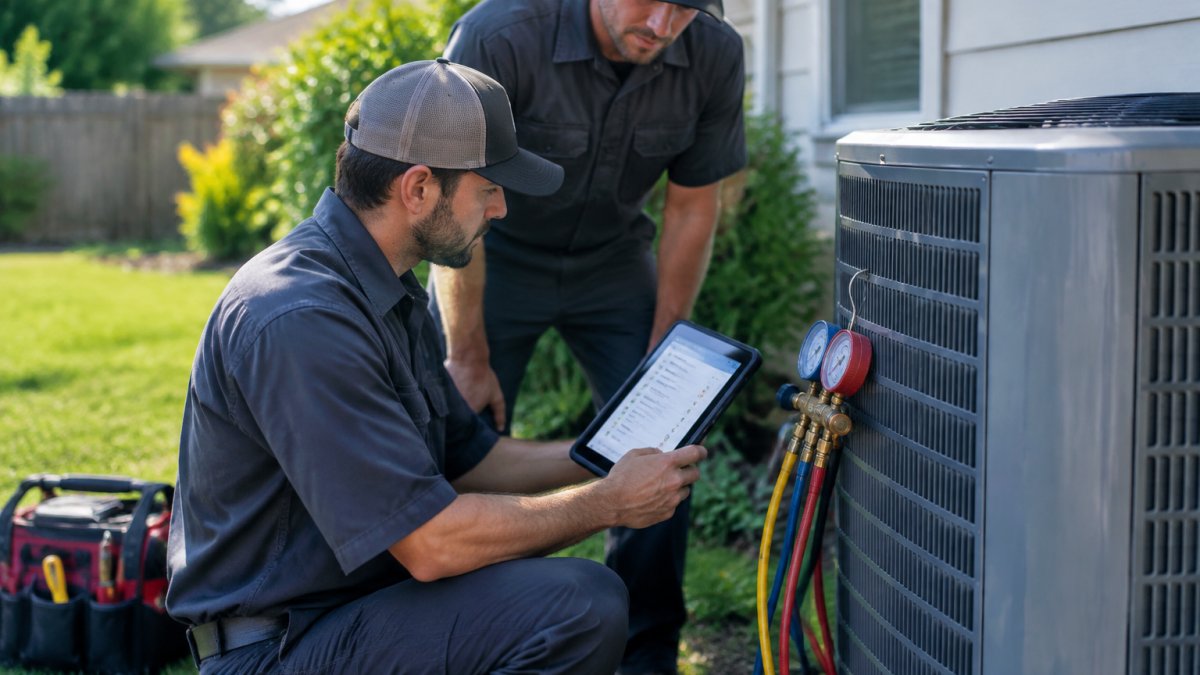
IoT monitoring is changing this fast. Sensors flag failing equipment before it breaks, so the first visit is planned around a known problem.
Our article on mobile app features for field service technicians covers the tools that make this work in the field.
Step 3: Connect Spare Parts Inventory to the Job
The number one reason for a repeat visit is a missing part. A tech diagnoses correctly, then drives away because the van lacks the component.
Connect spare parts inventory to the job and this stops. Dispatch checks stock before assigning the call. Techs see what is on the truck and what is at the warehouse.
Preventative maintenance plans make inventory planning easier, because you know what is coming. For the practical setup, read how to integrate dispatch software with inventory management.
Step 4: Use Field Service Management Software Benefits to Match Skills to Jobs
Sending the wrong tech is a silent killer of your first time fix rate. The right person with the right certification fixes it once.
Field service management software benefits show up here first. Technician skill matching routes specialized jobs to qualified techs. A septic pump issue goes to the tech who knows pumps.
This is where an all-in-one platform earns its keep. If you want to see how the whole workflow fits together, explore SolvPro's field service platform.
Step 5: Build Feedback Loops for Reducing Repeat Service Calls
Reducing repeat service calls starts with learning from them. Most teams never ask why a job came back. They just send someone out again. The gap most guides miss is that a feedback loop is a system with an owner, a cadence, and a written output, not a suggestion to "talk to your techs."
Capture the return reason at the moment it happens
The loop only works if the return reason is recorded when the second visit is booked, not reconstructed a month later. Add a required field to the return work order with a short, fixed list of causes: wrong diagnosis, missing part, wrong part, incomplete fix, customer misuse, or a new and unrelated problem. Fixed lists beat free text because they can be counted. A free-text field produces a thousand spellings of "didn't have the part" and no trend.
Run a weekly debrief, not an annual review
A common pattern is a 30-minute weekly review with the service manager, the lead dispatcher, and one rotating technician. The agenda is the same every week: the top three return causes by count, one job that came back, and one fix that should go into the knowledge base. Rotating the technician matters because the people doing the work see causes the office cannot.
Close the loop into the knowledge base and parts list
A debrief that does not change a document is a meeting. Every reviewed return should produce one of three outputs: a knowledge-base article, a change to the van stock list for that job type, or a dispatch rule that routes the job to a certified tech. If none of the three applies, the return was probably a new problem and should be tagged as such rather than counted against the tech.
Track the loop, not just the rate
Measure two things alongside first-time fix rate: the share of return visits with a recorded reason, and the number of knowledge-base updates per month. If the recorded-reason share is low, the field is being skipped and the loop is blind. If updates are zero, the debrief is not producing outputs.
- Log the reason for every return visit using a fixed cause list
- Tag repeat repairs by tech, part, and job type
- Review the top three causes each week with a rotating technician
- Update the knowledge base and parts list from every reviewed return
- Share fixes with the whole crew and track updates per month
Watch out: if return reasons are used to discipline individual technicians, they stop being recorded honestly and the loop goes dark.
This loop turns a repeat repair into a lesson. Over time, the same problem stops recurring. Data-driven decision making beats guesswork every time.
Step 6: Add AI and AR Where the Payback Is Clear
AI and AR can lift first-time fix rates, but only where the payback is obvious. Do not buy tech for its own sake. The useful question is not "should we add AI?" but "which failure mode is costing us the most repeat visits, and which tool attacks it?"
AI-driven predictive diagnostics
Predictive diagnostics work by learning from your own repair history. The model ingests work orders, part replacements, equipment age, run hours, and sensor readings, then flags the assets most likely to fail before the next scheduled visit.
The mechanism matters more than the marketing.
A recent industry survey found that nearly 75% of field service organizations report AI improves their first-time fix rates, according to Fieldwork HQ's 2026 field service trends. Treat that as a directional signal, not a guarantee for your operation.
AR remote guidance
AR is the newer play and the one most often oversold. Remote experts can guide a tech through a repair using a live overlay on the equipment, pointing at the exact connector or valve.
The practical constraint is bandwidth and workflow, not the headset. A remote expert has to be available when the tech calls, the connection has to hold inside a mechanical room, and the session has to be logged so the next tech can replay it.
A simple payback check
Run a cost-benefit check before you commit. The table below is a decision aid, not a price list.
| Tech Investment | Best For | Payback Signal |
|---|---|---|
| AI predictive diagnostics | High-volume, repeat repairs | Fewer wrong-part visits |
| AR remote guidance | Complex equipment | Fewer expert callbacks |
| IoT monitoring | Preventative maintenance | Fewer emergency calls |
To size the payback, count repeat visits per month, multiply by the average cost of a return trip (labor hours, drive time, and the part you should have carried), and compare that figure to the annual cost of the tool. When the highest-volume failure mode involves a part that is hard to locate, improving how technicians find items in storage can prevent another return trip just as effectively as choosing the right tool.
Watch out: buying AI before your asset registry and work-order history are clean produces alerts technicians do not trust, and a distrusted model is worse than no model.
Start with one tool, measure the change in repeat repairs for a single failure category, then expand. For the broader rollout sequence, see common challenges in field service digital transformation.
Common Mistakes That Undermine Technology Rollouts
Technology alone does not fix a broken process. The biggest rollout mistake is buying tools before your team agrees on definitions and workflow.
Watch out: rolling out new software without training your crews leads to workarounds and abandoned tools, and your first-time fix rate never moves.
Other common pitfalls:
- Skipping the benchmark, so you cannot prove improvement
- Digitizing paper without changing the workflow
- Ignoring bilingual needs, which causes on-site errors
- Chasing AI before the basics work
Digital transformation fails when it is treated as a purchase, not a process. For the deeper pitfalls, read common challenges in field service digital transformation.
Frequently Asked Questions
What is a good first-time fix rate for field service?
Many field service teams aim for a first-time fix rate in the range commonly cited across the industry. Falling below that range usually signals gaps in diagnostics, parts availability, or technician skill matching rather than a single bad process. Set your own target by segmenting jobs by type and technician, then compare each segment against the benchmark. A septic pump-out and a landscaping irrigation repair will not have the same achievable rate, so track them separately before judging overall performance.
How do you calculate first-time fix rate?
The first-time fix rate formula is simple: divide the number of jobs resolved on the first visit by the total number of jobs completed, then multiply by 100. For example, 80 first-visit resolutions out of 100 jobs equals an 80% rate. The harder part is defining what counts as a fix. Organizations must clearly define what a first-time fix means for their operation before technology can measure it. Decide upfront whether a return trip for a separate issue counts against the original job.
How does mobile technology impact first-time fix rates?
Mobile tools put job history, asset records, and troubleshooting guides in the technician's hands before and during the visit. That reduces the guesswork that causes return trips. Industry surveys have reported that many field service organizations believe AI use improves their first-time fix rates, and mobile access is usually the delivery channel for those recommendations. Start with digital work orders and a searchable knowledge base, then layer in diagnostic suggestions once your job data is clean.
What are the common causes of low first-time fix rates?
The usual culprits are incomplete job details at dispatch, technicians arriving without the right part, and no record of what happened on the previous visit. Poor skill matching makes it worse: sending a generalist to a job that needs a certified specialist almost guarantees a second trip. Reducing repeat service calls starts with capturing accurate information on the first call and closing the loop after every job. Review your repeat visits monthly and group them by cause to see which fix will pay off first.
A higher first-time fix rate is not about working harder. It is about giving your techs the right job, the right part, and the right information on the first visit. SolvPro brings scheduling, work orders, crew tracking, and job costing into one platform, with bilingual support and QuickBooks Online integration, so your team finishes jobs faster and gets paid sooner. Get started with SolvPro and turn repeat visits into first-visit fixes.